Thursday, 25 January 2018

It’s about time… by Phil Ralph


This year, in September, my partner Fern and I will be teaching a week-long residential course at the Centre for Alternative Technology. Entitled ‘Practicing the Art of Living’, the course will lead up to 12 participants through a cycle of change and transformation, exploring how they might live, work and create differently in this rapidly changing time.

Simply the mere act of writing that paragraph has given me the shivers… of anticipation, of delight, of shock and, above all, of fear. My mind and my ego are now bouncing around inside my head like two competing pinballs, utterly terrified at the prospect of what I am proposing to do. Rising above the cacophony of these two clacking balls is a repeating refrain. A single question, repeated over and over and over and over again –

Who do I think I am?

I never expected to be doing this. To be clear, I never even imagined I would be doing this. I have spent my life assuring myself and anyone who will listen to me that “I’m not a teacher, could never be a teacher, don’t know enough to teach anyone, am superstitious about the whole notion of teaching and what kind of an egotist would I need to be to presume that I had any knowledge that would be valuable enough to others for me to teach it?”


So, the questions I find myself asking are: why now? And what has changed?

And the answers are: It’s about time. And – everything.

Fern and I have now been together as partners for twenty years. In that time, my life has changed beyond all recognition. When we met in 1998, I was living in London and I was an actor. Today, we are living in the wilds of Wales (well, Llandeilo…) and I am a writer, performer, producer, facilitator and – yes – teacher. How the hell did that happen?

The full answer to that question would undoubtedly exhaust your generous attention span (thank you for reading this, by the way…) so let me give you a brief, two-word precis:

Breakdown. Breakthrough.

There you go. That’s 20 years of change in a nutshell. Simples…

Yeah, you guessed it -  it wasn’t really that easy. I mean, it was that pattern but… it didn’t happen just the once. Nor twice. Nor three times. It happened again. And again. And again. And again. And that was just in the last two minutes.

My (extremely belaboured) point is that change is not easy, it is not painless, and it isn’t simply a one-time thing. It is a seemingly endless process of challenge, loss, grief, depression, disassociation, denial, bargaining and ultimately acceptance that goes on throughout life, day in, day out. It’s a process of reimagining who and what I can be in this lifetime – and then doing it again, and again, and…

Wherever you look in the world, you can find aphorisms and sayings that encourage us to accept that life IS change. And that’s easy to accept when it’s just words. But living it – truly going through the process of having your dreams and expectations churned and chopped and discarded and rejected time and time again – is so much harder to do. In fact, it’s a lifetime’s practice… it’s an art…

One of the key things that enabled me to follow the path of change I have been living through in the past 20 years – apart from sharing my life with the most joyously questing human being it has ever been my privilege to know – has been a gradually burgeoning spiritual practice.

(****** SPIRITUALITY KLAXON ******** HE’S JUST MENTIONED THE ‘S’ WORD!!! EVERYBODY HEAD FOR THE EXITS!!!! WOOP!!! WOOP!!!!)

As you can tell, I’m something of a recovering cynic – as well as being a recovering actor and addict – and my take on spirituality from the cradle was pretty much encapsulated with a sneery shrug and some combination of the words – what, load, a, of, and knackers. But I discovered to my eternal gratitude that cynicism and a closed mind will only get you so far in life and in my case, it got me just as far as a nervous breakdown, physical illness and severe depression. Opening myself up to the notion that there might be “more things in heaven and earth, Horatio, than are dreamt of in your philosophy” has brought me endless riches – as well as endless challenges and opportunities to learn and grow.

One of the first things I did that began to open my mind was go on a silent meditation retreat at Gaia House in Devon. When I say I went “on a silent meditation retreat” what that actually looked like in practice was booking a place to go on a retreat FOR THREE YEARS RUNNING AND BOTTLING OUT EVERY SINGLE TIME BECAUSE I WAS ABSOLUTELY TERRIFIED before finally managing to pluck up the courage to spend a week in silence with other human beings, sitting on a cushion and letting my mind shout at me day and night. And once I finally got there, how was it? Well… 
When you see images of people meditating, they always look so blissful and calm, don’t they? And that is part of it, sure. For maybe one minute every five hours, if you’re lucky… The rest of the time the images should arguably look like the people are in a war zone, assailed from every side by thought after thought after thought… 
But, eventually, after time had slowed to a crawl and my senses had become refined and retuned and I began to watch my thoughts as one might watch the clouds passing across the sky – eventually, by the end of the week I had discovered something truly revolutionary. Ready?

I am not my mind.

God, what a relief, eh? From that point on there was no stopping me. Change and transformation here I come!!! Toot toot!!!

No, not really… At every stage of change, when I could possibly have resisted, you can be damn sure I resisted. I fought and kicked and screamed against letting go of any of the assumptions and desires I had in place for what I thought my life should be. I insisted that I would change no more. But life, as it so often does, had other plans. And, like it or lump it, change I would and change I must.

Now, some seven years after my first retreat, the list of things I do and have done that I could never possibly have imagined seems endless: I have a daily practice of sitting meditation; I have sat in more circles of total strangers undergoing profound spiritual and psychological distress than I could ever have imagined; I have undertaken a vision quest where I went alone into the wilds of north wales with nothing but minimal shelter and water to sustain me;  I have assisted others who have undertaken the same process; I have facilitated transformative gatherings, workshops, and walks; I have co-produced and directed with Fern a documentary series about the unique and wonderful spiritual activist, Satish Kumar; and I have trained as a Warrior for the Human Spirit with my teacher, Margaret Wheatley, and this year I will be stepping up to assist her in training others.

So, as you can see, when I say that everything has changed, I’m not even vaguely exaggerating.

So, why now? Why is it ‘about time’?

I’m 46 years old as I write this at the end of January 2018. I will be 47 in about eight weeks. On a personal level, I’m running out of time. Now, I know that the voice in your head that insists that you won’t ever die has balked at what I just wrote, but the absolute, ineluctable truth of it is I have less time ahead of me than there is behind me. Someday soon – terrifyingly soon – I will die. And I am absolutely certain that I want to be of service while I’m still here and offer some of the hard-won wisdom I have learnt to others.

I could spend the rest of my life asking the question ‘who do I think I am?’ I suspect we all could. Who do I think I am to teach, to guide, to speak, to stand up, to lead, to be generous, to think I have something to offer, to imagine I am talented, valuable, can be of service….? And the only answer to that I can offer is simple –

Who do I think I am? No-one. Just a human being. Alive for now, able and willing to serve for now. Curious, passionate, questing, failing, falling, laughing, crying. A human being. 

Time to get past that question then… That’s the personal level. So, why is it ‘about time’ on the global level?
I don’t really need to tell you, do I? You’re alive too. You know what’s going on, even if you do everything you can to protect yourself from it. None of us know what the future holds – for our species or the planet – but based on where we are right now, today, it doesn’t look good. At all. In fact, it looks really, really bad. And I could bed deep into my old friend, cynicism, and say that I’m alright and screw everyone else and the sky isn’t falling and why do I need to change and grow and share and love… I could do that. But I refer you to the paragraph above where I talked about the fact that I’m running out of time. We all are. Fast. Time to put up or shut up.
So, inspired and nurtured as I have been for the last 20 years by the love and awesome curiosity of my partner Fern, I’ve decided that it’s about time… It’s about time I offer whatever talents and learning I have in the service of others. It’s about time I set aside my fragile ego and my fear of failure and share my life’s learnings for the betterment of all. It’s about time that I accepted that being a teacher doesn’t mean I have to know everything or be everything. Quite the reverse. As I look around the world right now, the scariest, most dangerous people I see are the ones who claim they do know everything… And the most profound and valuable teachers are their opposites. The ones who have walked the path ahead of us and with deep humility and a sense of their own unimportance, share what they know in the hope it will be of service.

What I now know to be true to my very bones is that change is life and life is change. Nothing about that sentence is simple or easy (or grammatically correct…) but it is profoundly and undeniably true. I embrace life and change in all its complexity, beauty and harshness. For however long I have left, I commit to serving life. 
 

It’s about time...

I will also be teaching a couple of days on 'Changing the Frame: the Science and Art of Communicating for Transition' at Schumacher College in April. The course runs from Monday 19th March to Friday 6th April. Full details available here. 


Tuesday, 13 December 2016

Talks Walking 2, Chris Bird-Jones: 'The Light, the Worm, and the Bone' By Fern Smith


On the morning of 22nd February 2016 I pick up Chris Bird-Jones from her house high on one of the hills above the city of Swansea and we head west to Rhossilli at the tip of the Gower Peninsular. It is a full moon day and the weather looks promising. This is a place known well to both of us – the jewel in the crown of the oldest AONB (Area of Outstanding Natural Beauty) in the UK. It always feels like a special occasion going to Rhossilli - a place for high days and holidays - it has been one of my favoured Christmas day walks for many years. It’s a place of breathtaking beauty and spectacular coastal scenery, presided over by the majestic Worm’s Head, a long, dragon-shaped rocky outcrop. Facing the dragon stands the high ridge of Rhossilli Down, well-used by paragliders. Nestled between the two, is one of the longest unbroken stretches of golden sand in Wales.

Rhossilli Beach

Chris is the second artist I’ve asked to walk with me as part of my new ‘Talks Walking’ project. The idea is to discuss an invited individual artist’s work and their relationship to ‘spirit, soul and the sacred’. My first walk (A Walk in the Woods) had been with theatre maker Lucy Neal. The project was inspired by a book I’d read recently by Jacob Needleman that literally shook my world. In ‘An Unknown World’, Needleman asks the ultimate and ever so slightly daunting question, “what is the purpose of life on earth?” So no pressure then…


The drive to Rhossilli is taken up with sharing all our news, projects and challenges since we’d spoken last. There is lots to catch up on and the day could easily have continued in this way with us both sharing the day to day challenges and opportunities our daily lives present. This day is different. I have an agenda and want to put the focus on Chris, her work, what motivates and what keeps her doing what she does. Chris Bird-Jones was the ‘Creative Ambassador’ for Wales in 2015 - a highly prestigious and sought after award bestowed on a particularly prominent or questing artist in recognition of their work. It involves working closely with a venue in Wales as well as one overseas that the artist has developed a significant connection with. Chris is a glass artist, or more specifically one who works with light as her principal ‘material’. Chris had pioneered techniques and new ways of working with glass whilst a student at The RoyalCollege of Art. Moving away from more pictoral stained-glass windows, Chris instead worked with stacking glass, working more architecturally, experimenting with reflection and refraction. Twenty years ago, these ideas were so outside the mainstream of glass working that her ideas were not fully appreciated for what they were. However now, these methods and ideas have informed a whole generation of new artists who are working more experimentally with glass and the effect of light upon it.
 
Illuminated lens detail Hawaii 2015
Part of the deal with this particular project is that the invited artists get to choose the walk themselves. When I picked Chris up this morning, she immediately informed me, “I want to go to the sea!” We drive the forty minutes or so out of Swansea to Rhossilli and park in the National Trust car park. She has chosen an RSPB circular walk of around six miles which takes in the high cliffs, hidden bays, farm and heathland of this westernmost tip of Gower. Her school nickname was ‘Chris Birdy’. This feels appropriate given her attunement to things at the edge of consciousness, so often the case with a bird in flight at the furthermost reaches of our vision. Or similarly, a bird camouflaged by its stillness in the hedge or cliff top. Attending to the moment and to detail typify her work. Chris sees things. She notices and is continuously enchanted, “how can you ever feel tired of smelling a flower?”

She is someone who is often on the move. Currently she is living between North and South Wales, and appears as at home in Morocco as Hawaii, both of which she has visited this year. She speaks of how lucky she is to feel at home in so many different places. It is nature, she says, which helps her do this. She is able to dwell on this earth anywhere there are forests, rivers, sky, sea. Her attention to detail is striking and she is constantly drawing my attention to things I’ve barely noticed, like the way the water in the rock pools looks like snow - so strong is the reflection from the low wintery sun. She has the ability to connect with joy and the sense of adventure of a child exploring the world for the first time, as well as a desire to bend the rules, to climb over the fence marked ‘private’ – insatiable curiosity it could be called.
 
Illuminated lens detail Hawaii 2015.
Chris was 60 in January and has surprised herself that she is troubled by this. Since the beginning of 2016 there have been some notable high profile deaths of significant artists such as David Bowie, Alan Rickman and Lemmy. Added to this was the death of a dear school friend of Chris’s only a few days before. She speaks of the finiteness of time and how it is concentrating her mind. About the tension she feels between her art making, re-establishing an active connection with a Corbyn-revivified Labour Party and a desire to ‘just live’. By just living, it feels like it is the ‘art of living’ she wants to dedicate herself to – a simplifying, a re-aligning to what is important in life. And to walking. She speaks of walking as if it is an art-form, a meditation, an end in itself…

We speak about the fact that early on in her creative career, she left being solely an artist in order to teach. Partly desire and partly a pragmatic decision as she had her daughter to look after. Chris returned to her home of Llangollen and became head of department at NEWI (North East Wales Institute, now Glyndwr University), established residencies for Cywaith Cymru for a year and later taught the Masters course in glass at Swansea College of Art (now University of Wales Trinity St David), one of the nations most established centres for stained glass. She has always been an enabler and someone who found great satisfaction facilitating learning in others.

Since leaving teaching four years ago Chris has been re-connecting with and re-establishing her practice as an artist. Motivated by a need to bring more playfulness into life, she began to make everyday objects which ‘hold’ light – containers, buckets and bowls - significant, archetypal, timeless objects. The bowls were initially developed from an idea twenty-five years ago when she had her first major international exhibition in Hawaii. One of the pieces was inspired by an Hawaiian tradition whereby each new born child is blessed with a bowl of light within his or her belly. A bowl which can collect dirt, stones and rubble but can be daily washed clean in the sea. Chris says it is the magic and alchemy of light which draws her. Not the facts or science of light but something about the otherworldly transcendent nature of sunrise, sunset and the golden hour which enraptures the film-maker. A connection established when a child by means of a fascination with fairies.

Bowl of Light Hawaii 2015

The buckets and the bowls also reference traditional creation stories in which the universe is formed out of the ingredients of a great cauldron, as in the tale of the Welsh goddess Ceridwen who inadvertently created Taliesin, the bard of bards. Even more magically, a mirrored bucket or bowl also allows the holder to collect whatever is needed – to fill one’s bucket with the sky, sheep, birds, flowers. A bucket which is never full and however poor the owner be, can be filled with riches. Chris’ buckets appear to send an anti-materialist message of the highest order, though her work remains always playful and never pompous. 
 
Bucket portal 2016
Chris spoke of her connection to the mysterious. Admitting to feeling that she was on the edge of making a choice to go through a kind of threshold. But that if she did, there would be no turning back. She connects to the mystery continuously and intuitively in the making of her work but has difficulty putting it into words. Working with light seems to her a good metaphor for the mystery – holding something that cannot be held. A paradox. “The light is inseparable from the shadow. It is impossible to see if we do not have the light as well as the dark. The world would be unimaginable”. We sit on a bench in a field cordoned off from the general public and I read her the opening paragraph of Jacob Needleman’s book ‘The Unknown World, Notes on the Meaning of the Earth’…

“A month ago, on the night of my seventy-fifth birthday, I dreamed of Elias Barkhordian. I was once again sitting on the low stone wall surrounding our neighbour’s lawn, where Elias and I would always go to talk about the universe. As it had been then, over sixty years ago so it was in the dream, late afternoon in October, the sun low in the sky; in the distance the shouts of the neighbourhood children at their street games. And as it also was then, I had been walking away from the noise, pretending I was walking aimlessly but knowing I would be meeting Elias. And as for Elias, who soon appeared from across Seventh Street where the rich people lived, he was also pretending to be just walking, and when we met we pretended to be a little surprised – that was our ritual, played out for several years until Elias died just before his fourteenth birthday.”

The light of that day when Chris and I sat there overlooking Rhossilli beach was phenomenal. It had been overcast and rainy for days, months even. This day - where we spent at least six hours on a four-hour walk since we stopped countless times to look at things in detail - we met no-one. It was an empty landscape except for the grazing sheep, horses and ever-present birds. The light of the sky was magical. Grey, blue, pink, silver ever-changing as we walked that afternoon, the winter sun appearing and disappearing tentatively behind clouds in the enormous sky. The full moon preparing to reveal itself as the sun set over Worm’s Head. The light was our constant. The ever-changing light. Chris spoke of a new project, one nestled closely to her heart, still yet to be born. One which she hoped would mix the playfulness, the shadow, the light and which would entrance. Chris is a serious player. Enchanted. She sees things differently.
 
Chris Bird-Jones Toronto 2015


She picked up a bone. The single vertebrae of a sheep or a rabbit. “Look at it this way” she said, “it’s a smiling face with wings. Look at it this way – the smile is even wider…”


Chris Bird-Jones, artist and Creative Wales Ambassador 2015, lives in Swansea. You can contact her via her website chris-bird-jones.co.uk or on twitter @chrisbirdjones. Also see bird-jonesandheald.co.uk, ttps://lightexpedition.wordpress.com and https://www.facebook.com/Alldaith-Goleuni-Light-Expedition-by-Chris-Bird-Jones-1104935502865257 

Fern Smith is an artist and Creative Director of Emergence


Tuesday, 22 November 2016

What A Time For A Party… By Phil Ralph


So, I spent three weeks leading up to what shall henceforth be known as Trumpageddon away from home on a combined silent meditation retreat and workshop with my teacher, Margaret Wheatley. Without going into detail suffice it to say that in this crazy, frenetic, overstuffed world I heartily recommend some serious silence and contemplation.

Before I went away into the silence, my partner Fern – creative powerhouse and all round innovative thinker and doer – had nothing whatsoever planned. Some reading, some thinking, some dog walking. I would get back in early November and we would slide our way into the dark, cosy days of winter without too much on the agenda.

Imagine my surprise then when I reconnected to the internet, checked my emails and discovered that, almost overnight, Fern and a group of serial troublemakers – sorry, fellow creative powerhouses – Chris Bird-Jones, Phoebe Gauntlett, Thom Hill, Yanis Paikos, Jo Langley, Anna Piggott, Donna Males and Patrick Driscoll had decided that, a year on from our three events to mark the COP21 climate talks in Paris, we should host a one-off party to celebrate the amazing and innovative work that is going on in Swansea.


The event – entitled COParty 22 to coincide with the final day of this year’s COP (Conference of Parties) 22 in Marrakech – would bring together changemakers and innovators from around the city and county of Swansea to highlight and celebrate all the extraordinary grass-roots work that is going on in the areas of sustainability, environmental activism and community. And, most important of all, it would be a party! A celebration of all that is positive and outward looking. A (deeply compassionate) two-fingers to the doom-mongers and the naysayers who insist that 2016 has been the very worst year on record. They might not be completely wrong but they’re certainly not wholly right and we can prove it!

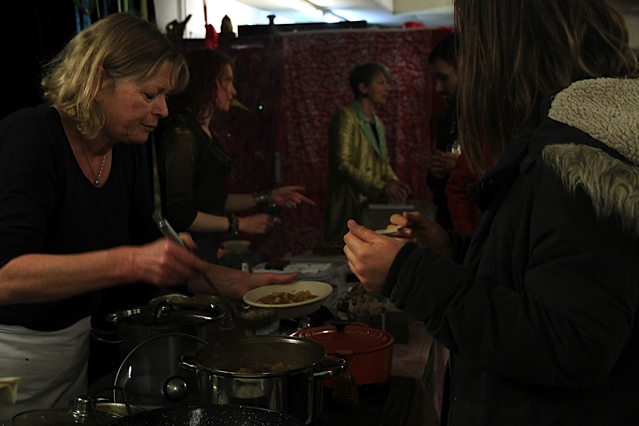
Friday 18th November 2016 dawned bright and breezy and the team began work in the same fashion. Yanis and myself convened at the home of spectacular cook, Judy Roots, to prepare huge, steaming pans of vegan tagine made from vegetables grown locally by Cae Tan (about whom more below), alongside tray after tray of carrot cake and luscious chocolate brownies. Meanwhile, Fern, Chris, Anna, Nazma and Phoebe – alongside various other assorted helpers, met at Volcano Theatre in the Iceland Building at the heart of Swansea’s now-famous High Street Cultural Hub and proceeded to transform the space into a little piece of Marrakech for the evening.


Judy Roots serves Vegan Tagine


Doors opened at 7pm and the space rapidly filled up with a wide variety of enthusiastic people, keen and eager for some good news and some good times. There was plenty to occupy them. In the small pop-up cinema, trailers and films from all the projects to be featured in the evening’s presentations played on a loop. My personal favourite being the incrediblymoving and beautiful film of the Awel Aman Tawe wind turbines being lifted into place on a cold autumnal morning. There was also a book shed where a range of publications dealing with issues around environmental activism, sustainability and spirituality could be perused. Another corner featured a table tennis table which did good service throughout the evening. And popping up throughout the space, Ross and Peter offered anyone who asked a game of 5asideCHESS, a terrific initiative seeking to generate conversation and connection through the oldest board game of all.

5asideCHESScorner


And, of course, the wonderful food provided by Judy Roots!

Once the crowd had reached critical mass (and we’re delighted and also saddened to say that we rapidly reached our capacity of 200 people and were forced to turn a few people away…) the evening began in earnest as the Aber Taiko drummers focussed everyone’s attention before Fern and I took the stage to set the scene. Then Jo and Ronnie brought more of the North African flavour with some beautiful belly dancing (which was a VERY tough act to follow) and then Fern and I began to introduce the evening’s speakers.

MC's Phil & Fern in Action


First up was Dan McCallum of Awel Aman Tawe. This extraordinary local initiative has, after 18 years of opposition and prevarication, harnessed local support and raised the funds to erect two huge wind turbines that will power 2,500 homes with all profits going towards local initiatives. This is a true example of local people working together to support each other towards a better future and it was a delight to have Dan with us. Shares are still available to support the project.

Awel Aman Tawe Turbines at Sunset


Next up was Tom O’Kane from Cae Tan, a Community Supported Agriculture project located on the Gower peninsula that is growing and supplying fabulous, locally grown organic veg to members throughout the year. They also offer opportunities for volunteering and learning for schools groups and local visitors. The food they produce tastes so much better than anything you can buy through mass produced agriculture and it was terrific to hear Tom speak about it so passionately.


And so the evening progressed. Speaker after speaker proved time and again that Swansea is teaming with local initiatives in the arts, creativity, sustainability and ecology – Down to Earth, the Environment Centre, Swansea News Network, Gower Power, VocalEyes, the Gaian Eco-village Project – the list goes on and on. As each speaker spoke it became apparent that this is a town and a community that is simply not waiting for those in power to decide to change how we do things. People in Swansea are doing it already! An crucial part of the evening was the significance of connecting the arts and creativity to sustainable initiatives. Increasing numbers of artists are committed to 'socially engaged' arts practices, and are now in Lucy Neal's words, "making art as if the world mattered". Hearing from Creative Wales Ambassador, Owen Griffiths and creating an enormous mural with Nazma Ali were high points of the evening for many.

Kate Denner from Down To Earth


Another burst of awe inspiring (and stomach massaging!) Aber Taiko drumming punctuated the evening in style before the party began in earnest. Those who wanted to follow up the speakers and ask more about their initiatives scattered to the four corners of the huge space at Volcano whilst Owen Griffiths and DJ Dave Phillips span the vinyl to keep the party going.

Aber Taiko Drummers in Action


It was a great night.

Now, those that know me will know that I’m usually the cynical, dour, ex-Yorkshireman predicting doom and disaster from the corner of any party of optimists. And, heaven knows, there is much to be afraid of in the current global and political landscape. But on this night, in this old shop, in a city where, as comedian Frankie Boyle recently said, “life would go on asnormal” in the face of global catastrophe – on this night I could see how being together with others, putting aside divisions and differences and working together for the good of all, could lead to a new and enriching way of life. Not only could it, it already is doing. We don’t have to imagine a more positive future. It’s already here. All we have to do is stand up and say we want to be part of it.

Frankly, if this is what Fern and Chris and Anna, Yanis and Jo come up with when I go away on retreat then I may have to go away more often… but then I’d miss all the fun.

Philip Ralph is a writer and a Director of Emergence

Images by Thom Hill and Ross Smith


Saturday, 12 November 2016

Talks Walking 1: A Walk in the Woods with Lucy Neal


We met at 10am on Tuesday 26th January 2016 at Chingford Station and prepared to walk together into the forest. I’d arranged with Lucy Neal, writer, theatre maker and creative catalyst to be my first companion on my ‘Talks Walking’ project in which I planned to interview pioneering arts practitioners engaged in ecological and social change. I asked her to choose a walk she wanted to do and my plan was that I would talk with her about her connections with soul, spirit and the sacred. I’d been inspired into ‘Talks Walking’ by reading Robert Macfarlane’s book ‘The Old Ways: A Journey on Foot’ which gave me the idea of the form and by Jacob Needleman’s ‘An Unknown World: Notes onthe Meaning of the Earth’, which provided me with my subject. Lucy’s chosen walk was a circular one through Epping Forest.


The plan began to unravel and reform itself in unexpected ways as soon as I’d made it. I worried that walking in Epping Forest, London’s largest green-space, might not be conducive to my interviewing Lucy. My fears were that we might spend too much time trying to orient ourselves along the right paths to avoid getting lost and not be able to give sufficient attention to our subject matter. I phoned her the day before our planned walk and asked if she’d consider instead a more linear, urban route along London’s canals. We would in this way at least be assured not to get lost in the landscape and be able to concentrate on the intended themes of our conversation.  Lucy was disappointed, saying she had never been to Epping Forest before and really had a yen to go. She had the right Ordinance Survey map (number 174) and was confident we would find our way both into and out of the forest, have time for our ‘Talk Walking’ and she would still be in time to catch the 14.40 train to Liverpool Street for her meeting in Hoxton at 16.00.

I decided to be fluid, let go of my original plan and just ‘see what happened’. I did wonder how we would be able to catch up with one another’s lives and projects and still have enough time to talk about my chosen themes from Needleman’s book - spirit, soul and the sacred. That morning I’d read a particularly significant chapter in the book entitled ‘The Real Reconciliation’. I imagined that as soon as she turned up at Chingford Station, that I would read it to her and then our conversation would evolve with me asking insightful questions, like: “What is the connection between creativity, social activism and faith?” And, “What is consciousness?” Or, “What is the role of a human being on earth at this particular time in history?” Instead, we left the station immediately, swept along with the happiness of seeing one another and walked in the direction of the Queen Elizabeth Hunting Lodge, with me clutching my printout of a four hour, seven and a half mile circular walk of the forest via Connaught Waters, Loughton Camp, High Beech and back to the Hunting Lodge and Chingford Station.

Queen Elizabeth Hunting Lodge, Epping Forest


We started off well enough according to plan, following the directions from my map, finding our way to Connaught Waters aided by asking some of the numerous dog walkers we met along the way. We then launched ourselves off  topic and off our planned route following our noses into the forest. I decided that Jacob Needleman and his questions might have to wait until another day. My quest to talk to artists about spirituality was perhaps destined to become more fantasy than reality.

Some time later, it started to drizzle. We sat down on a bench beneath a tree next to a portacabin café, not far from High Beech and had tea and flapjacks. Lucy started telling me of her recent work –leading ‘The Art of Writing Collaboratively’ for Arvon’s annual programme of residential courses, withCharlotte Du Cann. The invitation to do this came as a result of the publication of her book in 2015: ‘Playing for Time – Making Art as if the WorldMattered’ edited by Charlotte. This was their first experiment in sharing their collaborative writing practice with others. I listened to Lucy as she described some of the activities they had organised for and with the participants: being in dialogue with the earth; creating a fire walking ritual; publishing a newspaper (the first edition after a fictitious town’s major flooding); writing answers to the question, “What wants to happen through me”? and “What is my work in this world?” Even though Jacob Needleman’s book had not left my rucksack, Lucy started answering my unasked questions.


Later she spoke about Providence. How she leans into it and acts in relation to it, as it seems also to do with her. She spoke about the death of her mother and her finding herself going on pilgrimage to her mother’s grave, of her father’s interest in faith and theology. We spoke about a practice of art-making which is not just ‘creative change agent’ or ‘activist’, not just ‘space-maker’ or ‘documenter’, but which combines them all with an added deep connection to mystery. The word ‘God’ is not so much in Lucy’s vocabulary but ‘enthusiasm’ is. She appears to make the seemingly impossible happen. Lucy is often called an ‘optimist’ by other people – a word that appears to simple, too wide of the mark for what I believe she is. She agreed that this word did not sit comfortably with her. Instead she  talks about  it as simply, life happening through her. Her enthusiasm is perhaps a consequence of her life force. Watching Lucy is watching life in action. Full potential. The kind of energy that makes a tree a tree, a flower a flower, Lucy Neal, Lucy Neal. When she started to write Playing for Time she told me that she held some words close, almost like a mantra:

“If you will tell me why the fen appears impassable
I then will tell you why 
I think that I can cross it 
If I try”

There is something crucially important for Lucy about committing to and communicating her practice of ‘making art as if the world mattered’. She wants to encourage and create spaces for others to do this as well. ‘Taking our own permission,’ is one of the phrases I identify with her. However, she is a real permission giver for others as well as a permission taker for herself. She does not just tell stories, she creates a new language, a new structure and invites others to share in this. Lucy is appropriately named after the Latin for ‘light’ – she holds a torch, lighting the way for others to walk alongside, not just to follow her. She is a leader of a different sort – not one who is always in front but one who walks with you, pointing out the ladybird on the stone or the bluebell growing through the cracks on the pavement of a busy road.

We did not get to our destination. We failed at completing our seven and a half mile circular walk. It soon became obvious that we weren’t going to need the printout of the prescribed route, or the Ordinance Survey map, or even the GPS on my smartphone. We talked to people, the dog walkers, the people just out walking and taking the air, the perambulators, the forest guides. We became through our readiness to enquire, to not know, a part of a community – a temporary and fluid one but a community nonetheless. The forest gave us everything we needed. It held our enquiry, our searching, our desire to walk into the unknown, to take paths less travelled…

Finding ourselves back near the start of our walk at Butler’s Retreat, a café beside the Queen Elizabeth Hunting Lodge, we spoke of how not just her parents, but my mother, my father, and my brothers had also been a part of the day’s conversation. Earlier in the day she had named the notion that we have to bring our selves to collaboration. It can’t happen unless we do. The subject of my first ‘Talks Walking’ was intended to be Lucy. I had thought I might be the invisible, impartial interviewer. The walk had an energy and a direction of its own, as did the line of our enquiry. Our Talk Walking was a co-creation, not just with me but with the forest, the place itself. I had grown up in and around this forest, this area, been to school, attended church and become a teenager hanging around the streets near Chingford Station. It was twenty years, since my mother had died in 1996. Ten years before, I had been in this same café, about to embark on this same walk with my four brothers to scatter our mother’s ashes in Epping Forest. We had come out of the café – there, through the sun and drizzle was a double rainbow.

Four of the five Smith children (Scott taking the photo)

Lucy had chosen this walk. It had brought me back to my own mother. We spoke about both of our parents and why we might have incarnated though each of them. We knew we were privileged, drinking coffee in a café on the edge of a forest on a weekday afternoon. Neither of us had what could be referred to as sizeable incomes but we were privileged in so many ways and we knew it. What was the work that was being carried on through each of us – inherited possibly from our mother and fathers? How might each of us serve the Earth? How are we related to this living, interconnected universe, where we can speak of Systems and Gaia Theory but where it feels more difficult to talk about God?

At Butler's Retreat

I decided then and there to continue my ‘Talks Walking’ – to take this further, talk with other artists and to have Joseph Needleman and his book accompany me. Each of my companions would be given a copy of the book after the walk, but neither me nor Professor Needleman would prescribe where our conversation would wander. I would trust, as Lucy does in Providence. I would act in faith. I would lean into the unknown, the mystery, I would listen to what needs to come though me, through us.

Lucy got her train. The timing was perfect. We left Butler’s Retreat, and hurried back to Chingford Station, arriving two minutes before her train was due to leave. We then remembered that she was wearing my waterproof over-trousers which I’d lent her, to keep her red trousers from getting mud-splattered since she was going straight from the forest to a meeting with the Gulbenkian Foundation - her patent-leather smart shoes in her rucksack. With a minute to spare we both ran to her train, me outside on the platform, her inside the train, both of us struggling to get my trousers off her legs before the train left. We managed to do it and then both fell about laughing…me with my trousers, her pulling away on the train towards Liverpool Street. She texted me later saying “if we can do that we might be able to do anything…”


Earlier in the day I had asked her what she called herself given her role within the world of ‘transitional’ arts practice? She said, “Conductor”. “Lightening or Music” I had asked her, knowing she could be either?  Later in the same text, she said, “I think theatre-maker still stands, but in an expanded sense to include dramaturge and explorer of the story beat….I’m working on that….”

Lucy Neal is a theatre maker and writer. Her recent book is 'Playing For Time: Making Art As If The World Mattered' is published by Oberon Books

New Writing Course at Arvon 'Writing to Make Change Happen' by Lucy Neal & Charlotte Du Can

Fern Smith is an artist and Creative Director of Emergence